


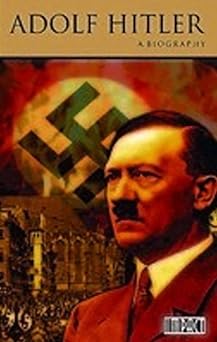
**Adolf Hitler: A Biography**
Adolf Hitler, born on April 20, 1889, in Braunau am Inn, Austria, remains one of history’s most infamous and controversial figures. As the leader of the National Socialist German Workers’ Party (NSDAP) and the architect of World War II and the Holocaust, his actions led to the deaths of millions and caused untold suffering around the world. This biography will explore his early life, rise to power, leadership, and the devastating impact of his rule.
### Early Life and Background
Adolf Hitler was born to Alois Hitler, a customs official, and Klara Hitler in a small town in Austria-Hungary, now part of Austria. His early years were marked by a difficult relationship with his father, a domineering man who had high expectations for his son. Hitler’s mother was more affectionate, and he grew particularly close to her, especially after the death of his younger brother, Edmund, from a sickness in 1900.
Hitler was a mediocre student and struggled with school, showing little interest in academics. He eventually dropped out at the age of 16 after the death of his father. For several years, he lived in Vienna, where he attempted to pursue a career in art. However, his application to the Academy of Fine Arts Vienna was rejected twice, which led to a period of economic hardship and frustration.
In Vienna, Hitler was exposed to a number of political and racial ideas, particularly anti-Semitic and nationalist sentiments that would later influence his ideology. His time in Vienna was also marked by his growing admiration for German nationalism and the ideas of racial purity, which were common in the pan-German movements of the time.
### World War I and Radicalization
In 1913, Hitler moved to Munich, Germany, where he was living when World War I broke out in 1914. He volunteered to serve in the Bavarian Reserve Infantry, despite having no formal military training. Hitler was a soldier on the Western Front, where he served as a messenger. He experienced the horrors of trench warfare and was wounded twice—once by a shell fragment in 1916 and again in 1918, which temporarily blinded him. He was in a military hospital when Germany surrendered in November 1918.
The defeat of Germany in World War I deeply affected Hitler, as it did many other Germans. The Treaty of Versailles (1919), which placed the blame for the war on Germany and imposed heavy reparations, was seen as a national humiliation. This sense of betrayal, known as the “Dolchstoßlegende” (stab-in-the-back myth), became central to Hitler’s later propaganda.
During the post-war years, Germany was politically unstable, and the economy was in ruin due to hyperinflation and the repercussions of the Versailles Treaty. Hitler became involved with right-wing nationalist groups in Munich, including the German Workers’ Party (DAP), which would later become the Nazi Party.
### The Rise of the Nazi Party
In 1919, Hitler joined the DAP, a small nationalist party led by Anton Drexler. Soon after, Hitler became the party’s chief propagandist, using his oratorical skills to attract followers. In 1920, the DAP changed its name to the National Socialist German Workers’ Party (NSDAP), and Hitler was instrumental in shaping its ideology. He promoted a platform that combined extreme nationalism, anti-Semitism, anti-communism, and a desire to overturn the Versailles Treaty and restore Germany’s former glory.
In 1923, Hitler attempted to seize power in what became known as the **Beer Hall Putsch**. The failed coup led to his arrest and a short prison sentence. During his time in prison, Hitler wrote *Mein Kampf* (“My Struggle”), a manifesto in which he outlined his vision for Germany, his hatred of Jews, and his belief in the need for Lebensraum (living space) for the German people, which would require territorial expansion in Eastern Europe.
After his release from prison, Hitler adopted a strategy of gaining power through legal means, building the Nazi Party’s base of support across Germany. The Great Depression (1929) played a key role in boosting Nazi popularity, as millions of Germans faced unemployment, poverty, and disillusionment with the Weimar Republic. The Nazi Party’s message of national revival, blame placed on Jews and communists for Germany’s problems, and promises of economic stability resonated with many segments of society.
### Ascendancy to Power
In 1932, the NSDAP became the largest party in the Reichstag, the German parliament. Despite this, Hitler did not immediately take power because he was unable to gain a majority in the Reichstag. After a series of backroom deals, President Paul von Hindenburg appointed Hitler as Chancellor of Germany on January 30, 1933.
Once in power, Hitler quickly moved to consolidate his control. The Reichstag Fire in February 1933 provided a pretext for Hitler to push through the Reichstag Fire Decree, which suspended civil liberties and allowed for the arrest of political opponents. In March 1933, the Enabling Act was passed, giving Hitler dictatorial powers and effectively dismantling the Weimar Republic’s democratic institutions.
With the Enabling Act in place, Hitler moved rapidly to establish a totalitarian regime. The Nazis began purging political opponents, both from the left (communists and socialists) and from the right (conservative nationalists and military figures). Hitler also took control of the media, suppressed dissent, and turned Germany into a one-party state.
### Nazi Germany and World War II
Under Hitler, Nazi Germany embarked on an aggressive foreign policy aimed at territorial expansion. In 1938, Germany annexed Austria in the **Anschluss** and demanded the Sudetenland region of Czechoslovakia. The policy of appeasement by Britain and France, which allowed Hitler to expand without significant resistance, emboldened the Nazi regime.
In 1939, Hitler invaded Poland, which led to the outbreak of World War II. Over the next several years, Nazi Germany conquered much of Europe, including France, Denmark, Norway, and large parts of the Soviet Union. Hitler’s policies of racial purity and territorial expansion resulted in the **Holocaust**, the systematic, state-sponsored persecution and murder of six million Jews, along with millions of Romani people, disabled individuals, Polish civilians, Soviet prisoners of war, and others deemed “undesirable” by the Nazis.
Hitler’s war effort eventually faltered. The invasion of the Soviet Union in 1941, and the subsequent defeat at Stalingrad in 1943, marked the beginning of Germany’s decline. The Allied invasion of Normandy (D-Day) in June 1944, followed by the relentless Soviet advance from the East, left Germany surrounded. Hitler’s leadership became increasingly erratic as the war turned against Germany.
### Decline and Death
By 1945, Germany was on the brink of collapse. The Allies closed in on Berlin, and Hitler retreated to his underground bunker. On April 30, 1945, as Soviet forces closed in on the city, Adolf Hitler committed suicide alongside his wife, Eva Braun, in the Reich Chancellery. Berlin fell to the Soviets soon after.
### Legacy and Impact
Adolf Hitler’s legacy is one of unparalleled destruction and suffering. His role in instigating World War II resulted in the deaths of an estimated 70-85 million people, or about 3% of the world’s population at the time. The Holocaust remains one of the most horrific crimes in human history, and his vision of a racially “pure” empire led to immeasurable human suffering and loss.
Hitler’s ideologies, including his extreme nationalism, anti-Semitism, and authoritarianism, continue to be studied and condemned worldwide. His rise to power and the subsequent atrocities of the Nazi regime serve as stark reminders of the dangers of unchecked power, totalitarianism, and hatred.
In the postwar era, Hitler became a symbol of evil, and his life and actions have been the subject of extensive historical inquiry and debate. His story remains a tragic and sobering chapter in the history of the 20th century.
Only logged in customers who have purchased this product may leave a review.
Related products
biographies books
Five Presidents: My Extraordinary Journey with Eisenhower, Kennedy, Johnson, Nixon, and Ford


biographies books
The Greatest Beer Run Ever: A Memoir of Friendship, Loyalty, and War



Reviews
There are no reviews yet.