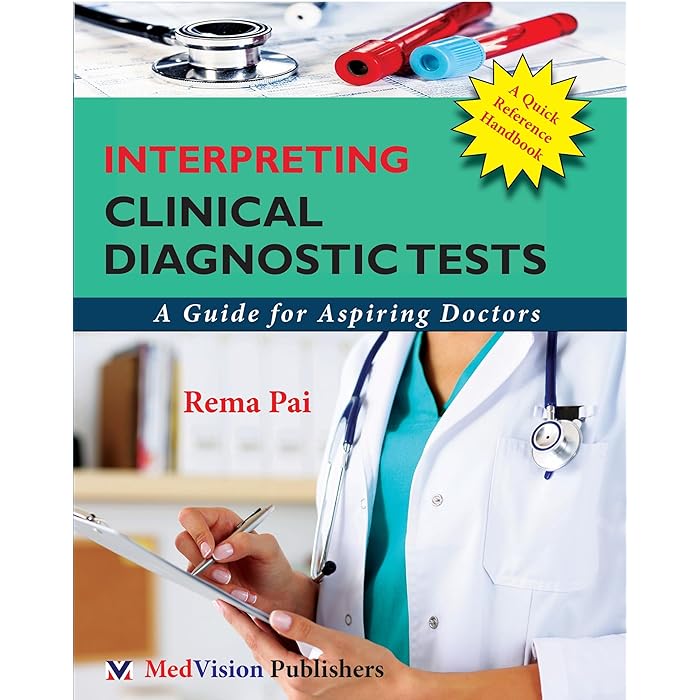
Description
Interpreting clinical diagnostic tests involves evaluating test results in the context of a patient’s clinical history, symptoms, and physical examination. The goal is to use these results to diagnose, monitor, or predict the course of a disease or condition. Below are key aspects to consider when interpreting clinical diagnostic tests:
### 1. **Test Sensitivity and Specificity**
– **Sensitivity**: The ability of a test to correctly identify those with the disease (true positive rate). A highly sensitive test is good at ruling **out** disease (i.e., if the test is negative, you can reasonably be confident that the disease is not present).
– **Formula**: Sensitivity = True Positives / (True Positives + False Negatives)
– **Specificity**: The ability of a test to correctly identify those without the disease (true negative rate). A highly specific test is good at ruling **in** disease (i.e., if the test is positive, it is more likely that the disease is actually present).
– **Formula**: Specificity = True Negatives / (True Negatives + False Positives)
**Example**: If a test for a disease has high sensitivity but low specificity, it may produce many false positives (incorrectly identifying healthy individuals as diseased). Conversely, if a test has high specificity but low sensitivity, it may miss many true cases (false negatives).
### 2. **Positive Predictive Value (PPV) and Negative Predictive Value (NPV)**
– **PPV**: The probability that a person who tests positive actually has the disease. PPV depends not only on test sensitivity and specificity but also on the **prevalence** of the disease in the population.
– **Formula**: PPV = True Positives / (True Positives + False Positives)
– **NPV**: The probability that a person who tests negative truly does not have the disease.
– **Formula**: NPV = True Negatives / (True Negatives + False Negatives)
These values are particularly useful in clinical practice to understand the likelihood that a positive or negative test result is correct.
### 3. **Prevalence**
– The prevalence of the disease in the population can significantly impact the predictive values. In populations with low prevalence, even a test with good sensitivity and specificity can have a low PPV (many false positives). Conversely, in high-prevalence populations, the PPV increases because the likelihood of having the disease is higher.
### 4. **Likelihood Ratios (LR)**
– **LR+** (positive likelihood ratio) = Sensitivity / (1 – Specificity)
– **LR-** (negative likelihood ratio) = (1 – Sensitivity) / Specificity
Likelihood ratios give clinicians an estimate of how much more likely a disease is after a positive or negative test result. They are useful because they can be applied to any pre-test probability (e.g., the likelihood of disease before the test) to calculate post-test probabilities.
– **LR+ > 10**: Strong evidence that the disease is present.
– **LR- < 0.1**: Strong evidence that the disease is not present.
### 5. **Clinical Context and Pre-test Probability**
– The clinical presentation, history, and risk factors of the patient (e.g., age, gender, family history, environmental exposure, comorbid conditions) are crucial in interpreting test results. A test result should always be viewed in light of the likelihood of the disease based on the patient’s overall clinical picture.
– For instance, a highly sensitive test for tuberculosis might be a good choice in someone with risk factors like travel history or immunosuppression.
### 6. **Interpretation of Test Results in Combination**
– In many cases, multiple tests may be used to confirm or exclude a diagnosis. The strategy may involve:
– **Sequential Testing**: A highly sensitive test may be used first to rule out disease (if negative, the disease is excluded), followed by a more specific test if the result is positive.
– **Simultaneous Testing**: Two or more tests are performed at the same time to increase diagnostic certainty.
### 7. **False Positives and False Negatives**
– **False Positives**: A test result that incorrectly indicates the presence of a disease. It can lead to unnecessary treatments or further testing.
– **False Negatives**: A test result that incorrectly indicates the absence of a disease. This can delay appropriate treatment or miss a diagnosis altogether.
### 8. **Test Reliability and Quality Control**
– The **reliability** of a test depends on its **precision** (repeatability of results) and **accuracy** (closeness to the true value).
– Quality control measures, such as calibration of equipment and monitoring of reagents, are essential for ensuring consistent and accurate results.
### 9. **Impact of Pre-existing Conditions**
– Some underlying health conditions or medications can interfere with diagnostic test results. For example, autoimmune diseases can cause false positives in certain serological tests, or certain medications might affect liver enzyme levels.
### 10. **Interpretation in Special Populations**
– Test results may vary based on age, sex, pregnancy, and other factors. For instance, pregnancy can affect many laboratory values (e.g., blood cell counts, hormone levels), and certain tests may need adjustment based on these factors.
### Example: Interpreting a Rapid Strep Test
Consider a rapid strep test for diagnosing **group A streptococcal (GAS) pharyngitis**.
– If the test has **high sensitivity** (e.g., 90%) and **high specificity** (e.g., 95%), a negative result would suggest that strep throat is unlikely, but a positive result would strongly suggest the presence of GAS infection.
– In a low-prevalence population (e.g., a clinic in the summer), even a positive rapid strep test might have a lower **PPV**, meaning other diagnostic methods might be used (such as throat culture) to confirm the diagnosis.
– Conversely, in a high-prevalence setting (e.g., an outbreak), the **PPV** would be higher, and treatment could be started immediately based on the positive test result.

































































































Reviews
There are no reviews yet.