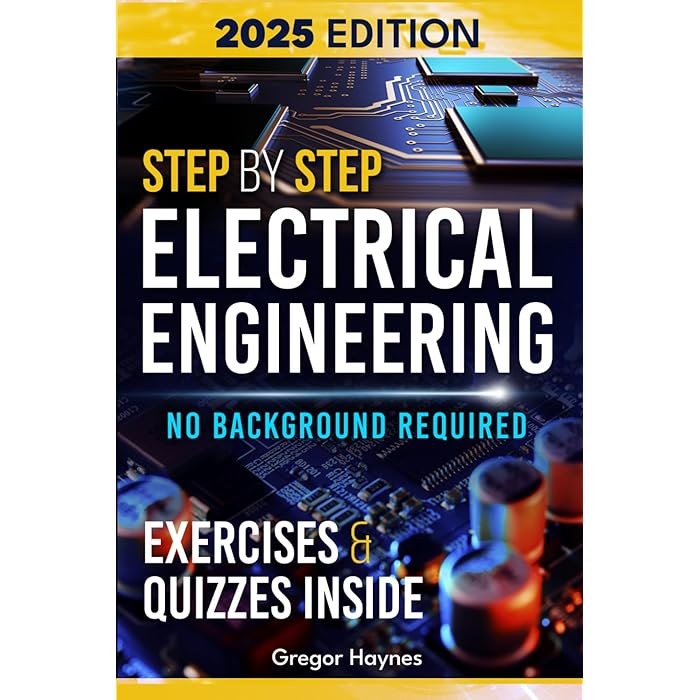
Description
Electrical engineering is a vast field that deals with the study and application of electricity, electronics, and electromagnetism. It spans a wide range of topics, from circuit design to power generation, communication systems, and control systems. Below is a step-by-step breakdown of the fundamental topics and learning path in electrical engineering.
### Step 1: **Foundations of Electrical Engineering**
Before diving into specific subfields, you should build a strong foundation in basic math and physics.
#### 1.1 **Mathematics**
– **Calculus** (single-variable and multivariable)
– **Linear Algebra**
– **Differential Equations**
– **Complex Numbers**
– **Probability and Statistics** (for signal processing and noise analysis)
#### 1.2 **Physics**
– **Classical Mechanics**
– **Electromagnetism** (Maxwell’s equations)
– **Circuit Theory** (basic electrical concepts)
Understanding these fundamentals will be essential for solving real-world engineering problems.
—
### Step 2: **Basic Electrical Concepts**
Once the foundation is in place, you can start with the basics of electrical engineering.
#### 2.1 **Electricity and Magnetism**
– **Ohm’s Law**: \(V = IR\) (Voltage = Current × Resistance)
– **Kirchhoff’s Laws**:
– Kirchhoff’s Current Law (KCL)
– Kirchhoff’s Voltage Law (KVL)
– **Power and Energy**: \(P = IV\) (Power = Current × Voltage)
#### 2.2 **Components of Circuits**
– **Resistors**, **Capacitors**, **Inductors**: Basic passive components
– **Power Sources**: Voltage sources, Current sources
– **Active Components**: Diodes, Transistors (introduces you to semiconductor devices)
#### 2.3 **Basic Circuit Analysis**
– **Series and Parallel Circuits**
– **Voltage Dividers**
– **Current Dividers**
– **Thevenin’s and Norton’s Theorems**
—
### Step 3: **Circuit Analysis and Design**
With basic concepts in hand, you can dive into more advanced circuit analysis.
#### 3.1 **AC and DC Circuit Analysis**
– **DC Circuits**: Steady-state analysis of circuits with DC sources
– **AC Circuits**: Introduction to alternating current (AC), phasor diagrams, and impedance
#### 3.2 **Transient Analysis**
– **RC, RL, and RLC Circuits**: Solve for time-dependent responses
– **Laplace Transforms**: For analyzing circuits in the s-domain
#### 3.3 **Frequency Response**
– **Impedance and Admittance**: For AC analysis
– **Bode Plots**: Frequency response of circuits
#### 3.4 **Fourier Transform and Signal Processing**
– **Fourier Series**: Decomposition of periodic signals
– **Fourier Transform**: Analyze non-periodic signals
—
### Step 4: **Electronics and Semiconductor Devices**
At this stage, you will learn how electronic components operate and how to design circuits with them.
#### 4.1 **Diodes**
– **Ideal Diode Models**
– **Rectifiers**: Half-wave, Full-wave, Bridge rectifiers
– **Zener Diodes**: Voltage regulation
#### 4.2 **Transistors**
– **BJT (Bipolar Junction Transistor)**: Current amplification
– **MOSFET (Metal-Oxide-Semiconductor Field-Effect Transistor)**: Voltage-controlled devices
#### 4.3 **Operational Amplifiers (Op-Amps)**
– **Inverting and Non-inverting Amplifiers**
– **Filters**: Low-pass, High-pass, Band-pass filters
– **Feedback Systems**: Negative and positive feedback
#### 4.4 **Digital Electronics**
– **Logic Gates**: AND, OR, NOT, XOR
– **Combinational and Sequential Circuits**: Flip-flops, counters, multiplexers
– **Microcontrollers**: Basic programming and interfacing
—
### Step 5: **Power Systems and Electrical Machines**
Now, let’s delve into the field of electrical power generation, distribution, and machines.
#### 5.1 **AC and DC Power Systems**
– **Generation and Distribution of Power**: How electrical power is generated, transmitted, and distributed
– **Transformers**: Voltage step-up and step-down
– **Power Factor**: Importance in power distribution
– **Transmission Lines**: Line losses, impedance, and efficiency
#### 5.2 **Electrical Machines**
– **DC Motors and Generators**
– **AC Motors**: Induction and synchronous motors
– **Transformers**: Types, working principles, and applications
#### 5.3 **Power Electronics**
– **Rectifiers and Inverters**: AC to DC and DC to AC conversion
– **Thyristors and Triacs**: Controlled rectification
– **DC-DC Converters**: Buck, Boost, and Buck-Boost converters
—
### Step 6: **Control Systems**
Control systems are central to automation and feedback systems.
#### 6.1 **Feedback Systems**
– **Open-Loop vs Closed-Loop Control**
– **Transfer Functions**: Mathematical description of systems
– **Stability Analysis**: Nyquist, Bode, and Root-Locus plots
– **PID Controllers**: Proportional, Integral, and Derivative control
#### 6.2 **Control System Design**
– **State-Space Representation**: Modeling dynamic systems
– **Control Strategies**: Adaptive control, optimal control, robust control
—
### Step 7: **Communication Systems**
Communication is a critical aspect of modern electrical engineering.
#### 7.1 **Signal and Systems**
– **Analog Signals vs Digital Signals**
– **Modulation and Demodulation**: AM, FM, PM
– **Digital Communication**: Sampling, quantization, pulse code modulation (PCM)
#### 7.2 **Communication Theory**
– **Fourier Series and Transform**: Signal processing in communication
– **Noise and Signal-to-Noise Ratio (SNR)**
– **Error Detection and Correction**: Hamming code, CRC
#### 7.3 **Wireless and Optical Communication**
– **Modulation Techniques**: ASK, PSK, QAM
– **Antennas and Propagation**
– **Fiber Optic Communication**: Light-based transmission
—
### Step 8: **Advanced Topics and Specializations**
Once you have a grasp on the core principles, you can choose to specialize in specific areas within electrical engineering.
#### 8.1 **Embedded Systems**
– **Microcontroller Programming**: Arduino, Raspberry Pi, and others
– **Sensors and Actuators**: Interfacing and control
– **IoT (Internet of Things)**: Connectivity and wireless communication
#### 8.2 **Power System Protection**
– **Relays and Circuit Breakers**
– **Fault Detection and Isolation**
– **Smart Grids**
#### 8.3 **VLSI Design**
– **CMOS Technology**: Integrated circuits at the micro-level
– **Digital Design**: HDL (Hardware Description Language) – VHDL, Verilog
#### 8.4 **Renewable Energy**
– **Solar Power Systems**
– **Wind Energy Systems**
– **Energy Storage**: Batteries, Supercapacitors
—
### Step 9: **Practical Skills and Hands-On Projects**
Electrical engineering is not only about theory but also about practical application. It’s essential to gain hands-on experience.
– **Circuit Design**: Using simulation tools (like SPICE, LTSpice, or MATLAB) and building physical circuits.
– **Lab Work**: Work with oscilloscopes, function generators, multimeters, etc.
– **Prototyping**: Use microcontrollers like Arduino, Raspberry Pi, or FPGA boards to build projects.
—
### Step 10: **Stay Updated and Continuously Learn**
Electrical engineering is a rapidly evolving field, and it’s essential to stay updated.
– **Conferences**: Attend conferences and workshops.
– **Online Courses**: Platforms like Coursera, edX, or MIT OpenCourseWare offer advanced courses.
– **Research and Development**: Keep an eye on journals like IEEE Transactions.
—


































































Reviews
There are no reviews yet.