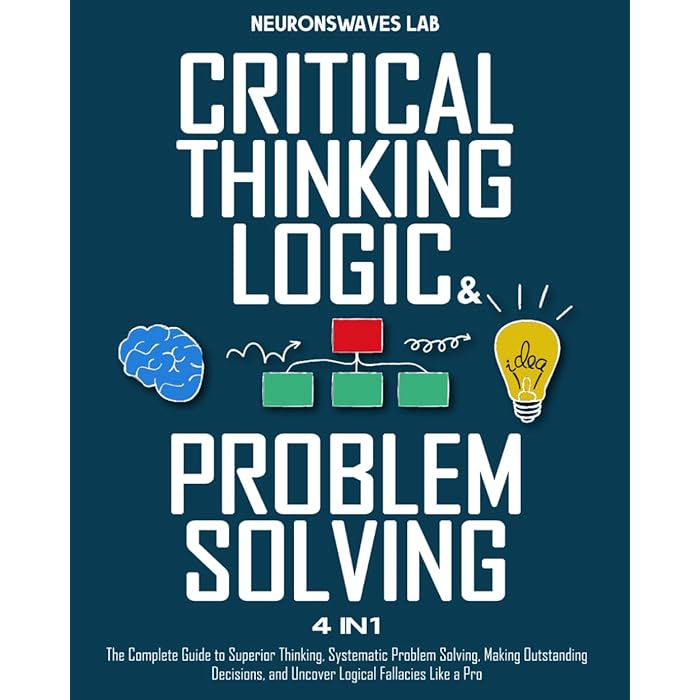
Description
Critical thinking, logic, and problem-solving are interconnected skills that are essential for decision-making, learning, and understanding the world. Here’s a breakdown of each concept and how they work together:
### 1. **Critical Thinking**
Critical thinking is the ability to analyze, evaluate, and synthesize information in a reasoned and logical manner. It involves:
– **Questioning assumptions**: Challenging what is taken for granted.
– **Evaluating evidence**: Weighing the reliability and relevance of the information provided.
– **Identifying biases**: Recognizing personal or societal biases that can distort reasoning.
– **Drawing conclusions**: Arriving at well-supported conclusions based on the available evidence.
### Key Components of Critical Thinking:
– **Clarity**: Being clear about the question or issue at hand.
– **Precision**: Ensuring that reasoning is specific and accurate.
– **Relevance**: Making sure that the information is directly related to the issue.
– **Depth**: Looking beyond the surface to explore complexities.
– **Breadth**: Considering alternative perspectives.
– **Logic**: Making sure reasoning follows a structured, coherent pattern.
### 2. **Logic**
Logic is the formal system of reasoning that helps us to make valid inferences. It provides the structure for drawing conclusions from premises. There are two types of logic:
– **Deductive reasoning**: Drawing specific conclusions from general premises. If the premises are true, the conclusion must be true.
– Example: All humans are mortal (premise), Socrates is human (premise), therefore Socrates is mortal (conclusion).
– **Inductive reasoning**: Drawing general conclusions based on specific observations. The conclusion is probable but not guaranteed.
– Example: Every swan I have seen is white, therefore all swans are white.
**Logical fallacies** are common errors in reasoning that can undermine arguments. Examples include:
– **Ad hominem**: Attacking the person making the argument rather than the argument itself.
– **Straw man**: Misrepresenting someone’s argument to make it easier to attack.
– **False dichotomy**: Presenting only two options when more exist.
### 3. **Problem Solving**
Problem solving is the process of finding solutions to difficult or complex issues. It involves several stages:
1. **Identifying the problem**: Recognizing that a problem exists.
2. **Defining the problem**: Clearly articulating what the problem is and breaking it down into manageable parts.
3. **Generating possible solutions**: Brainstorming different approaches.
4. **Evaluating options**: Assessing the feasibility, pros, and cons of each solution.
5. **Implementing the solution**: Taking action to solve the problem.
6. **Reviewing the results**: Reflecting on the outcome to ensure that the solution was effective and making adjustments if necessary.
**Problem-solving techniques** include:
– **Root cause analysis**: Identifying the underlying cause of a problem.
– **Brainstorming**: Generating a wide range of potential solutions.
– **Trial and error**: Trying different approaches and learning from failure.
– **Algorithmic thinking**: Using step-by-step procedures to solve structured problems.
### How They Work Together:
– **Critical thinking** provides the foundation for analyzing and evaluating situations effectively.
– **Logic** ensures that conclusions are valid and based on sound reasoning.
– **Problem solving** uses critical thinking and logic to identify, evaluate, and implement solutions to problems.
For example, in a work scenario, you might:
1. **Use critical thinking** to identify the core issue (e.g., a drop in sales).
2. **Apply logic** to understand why this might be happening by analyzing data (e.g., correlating sales with marketing efforts).
3. **Use problem-solving** techniques to devise and test solutions (e.g., improving marketing strategies or introducing a new product feature).






Reviews
There are no reviews yet.